Saturday, September 25, 2010

Photography: A Critical Introduction - 1. Thinking about Photography

The book starts with a chapter written by the editor Liz Wells and Derrick Price, covering the broad gamut of the history of photographic thought, theory and to some extent how it is practiced.  The study is clearly upon the image and not the photographer.  It is not practical to summarize the whole chapter, which is in a sense a summary of multiple other works, rather I will extract some key learning points and present them as a list.

As photography started in the middle of the 19th century it was hailed as bringing a new objectivity, photographs were an accurate record of reality.  However, this meant that it was very much viewed as a science and not as an art - photographers were seen as operators not artists.  Baudelaire commented: "if photography is allowed to deputize for art in some of art's activities, it will not be long before it has supplanted or corrupted art altogether" (1859).  How wrong he was!

However, photographers responded in two distinct ways, which I think are still prevalent amongst much vernacular photography today:

  1. The Pictorialists attempted to reproduce a painterly style, copying the aesthetic of painted work, even resorting to blurring the image or using printing techniques that added an artistic look.  I consider this to still persist today in the ongoing obsession with sunsets and long exposures of water adding that "dreamy" look to sea shores
  2. The Straight photographers specifically sought out to create accurate records of what they saw before them, continued in much modern American photography.
The emphasis that photography document and then conveys facts persisted for quite some time.  One of the first to really dispute this was Walter Benjamin, who stated in the 1930's that a photograph must be viewed within the sociopolitical circumstances in which it is viewed.  In other words a photograph will be interpreted in the context of the times in which it is exhibited.  Interestingly at this stage there still seemed to be limited discussion of the act of photographing and the influence of the photographer within the photograph.

The book then moved onto modernism, one of the ism's I am struggling to understand and place in the context of other ism's.  Here photography was seen as bringing facts to the attention of the politicians of the age.  Also its very technological way of capturing images, aligned to the ongoing obsession with progress and mechanization.  Post-modernism has to be understood in response to modernism, given that I am struggling with the latter the former is even more difficult to understand.  The text at this stage seems to assume an understanding of both and as such loses its claim to be "introductory".

My take on the postmodern (and this will need to be reviewed later) is that it does away with any claim of authenticity and requires that the photographic image can only be read in relation to all other contemporary influences. 

Stepping into a description of theory the book postulates that there are two basic debates in theory of photography:
  1. The relationship of a photograph to reality
  2. How a photograph is read
Photography is seen to be particularly vulnerable to divergent views as it is at the cusp of science, social science and art.  I can relate strongly to this as it is this very fact of bringing together the science of image capture, with the social elements of what is contained within the image, and its presentation as art that has led me to being on this course of study.

The chapter from this point on presents a history of theoretical ideas and the development of writing on the history itself of photography - good source material, but very difficult to summarize.  Rather I want to comment on two theoretical concepts that appeal to me:
  1. Semiotics - the science of signs.  The idea that we can codify the meaning of a photograph using signs, which are the conceptualization of media within logical systems.  Although I cannot admit to fully understanding this, it is the further idea that the semiotics of the picture, must be combined with that of the viewer, a concept from psychoanalysis that appeals.  In other words no matter how the meaning of a photograph is logically decoded, the reading must also take account of the sociology of the reader.
  2. The division of the content of a photograph by Roland Barthes into the Studium and Punctum.  The Studium refers to the general look and feel of the images, whilst the Punctum is an occasional piece of content that immediately arrests out attention.  A "good: photograph must exhibit both and perhaps explains why some photographs jump out of the page, whilst others whilst aesthetically pleasing are banal in appearance.
Neither of these concepts actually explain why we like or dislike an image, but they do start to built a reference model to understand what builds up like or dislike.

The chapter also includes a very good case study of the "Migrant Mother" by Dorothea Lange and cleverly points out the many meanings of this photograph and how it relates to the reality of the time it was photographed, all is not quite as it seems!

The Theoretical Basis of Photography

In the last few months I have focused much of my energy on taking photographs and working through the exercises and assignments in People and Place.  I have also worked steadily through an expanding bookshelf of works concerning themselves with either technique, critical theory, or discussion of a particular photographer.  Currently my bookshelf is growing faster than my reading pace, although this is in part due to a desire to create a small library of photographers images to furnish ideas for the upcoming assignments 4 and 5.  My recent acquisitions include books covering Alfred Stieglitz, Fay Godwin, Jeff Wall, Andreas Gursky, and a wonderful volume covering the key photographers from the Düsseldorf School of Photography.

However, a greater interest has been in reading more about Critical Theory in Photography and how the current thought processes at any given time influenced the subject matter and style of contemporary photographers.  Many years ago I studied as a Theoretical Physicist and worked for 2 years as a research fellow at Imperial College's physics department, before realizing that my future was in the IT industry.  Back then I read extensively around my subject digging deeply into theory or the testing of theory through experiment.  However, this theory was all grounded in Physical Principals and explained through the very precise medium of mathematics, a concept had a clear beginning and end, it could be right or wrong, proof came through its ability to predict reality.  Theory built models of the observable world to either explain or predict phenomena, experiment then sought to confirm or tear down.  A complex, but structured world.

Clearly reality was more complex that I have just described, personality and fashion influence science as with any other subject area, however, Mathematics underpinned all with a rigorous structure.  Coming to artistic theory I feel as if I have landed on a different planet.  The concepts that I have come across are complex, however, they are obscured by language that seems to exist simply to hide the meaning of what is being said.  I realize that I have much to learn, but did not realize that my vocabulary was so lacking.  Beyond the challenge of the academic language, the concepts themselves are very nebulous and difficult to pin down, ideas seem to drift with time and fashion, absolutes or axioms do not exist or themselves seem to drift in meaning.  This is all very different from scientific theory, however, it is interesting and understanding such theory is critical to appreciating why modern photographic art deals with the subjects and structures that it does.  I also suspect that as I progress into the latter stages of this course such an understanding will be assumed not desired.

At present I am wrestling with how to go about developing a deeper understanding. The course "Visual Studies 1: Understanding Visual Culture" looks appealing and would certainly be an excellent solution to learning about theory of how we look at art.  However, I am reluctant to commit to a course that is very much book learning based, I am getting so much pleasure out of the photographic modules of the course.  The choice for completing the year 1 courses is this or DPP, which I am also not so sure of, I already have a good understanding of Digital Photography developed through working the first two courses and my general photographic practice.  It seems that my options after completing PaP are:

  1. Embark upon DPP
  2. Embark upon Visual Studies 1: Understanding Visual Culture
  3. Slightly ambitious, but do VS1 in parallel to a level 2 course, permitting a mix of photography and theoretical study
I think this is a topic for some external advice, my tutor should be able to help and perhaps the forums could be a good place for debate around this.

In the meantime, I am not going to wait so am slowly working my way through Photography: A Critical Introduction, edited by Liz Wells.  This is the recommended introductory text to critical theory on the book list for both AoP and PaP.  I must admit that whilst doing AoP I think this might have been rather intimidatory, however, now working on PaP I think it is essential.  


Thus far I have read the first two chapters of the book and was happily plowing through it, but was not really fully taking in what I have learned.  Study skills are not really taught to Physics students, learning is more through reproducing the maths and extending it through solving parallel problems.  Sitting and reading a complete book was unknown to me at the time, perhaps the reason I am no longer a physicist.  Subsequently I have decided to step back a little and reflect upon what I am reading, the concepts are not hugely difficult, but need serious consideration.  I have decided to read the book a chapter at a time and briefly blog, chapter by chapter, the key points and what I understand of them.  

Monday, September 20, 2010

Assignment 1 & 2: Feedback

I have been rather slow to update this blog with responses to my tutors feedback on the first 2 assignments.  This is primarily because, I am pleased to say, the the feedback was very positive and did not indicate that I needed to change or rework any of the images.

For assignment 1 there were some very constructive comments, particularly on the theme of less is more, especially when applied to studio lighting.  The first image I used did suffer from the use of too many lights, 4 in this case:


The image is too flat and the highlights too strong, I have in effect suppressed the modeling of the face by over illuminating it.  An image I created for my first exercise on the course had better modeling and perhaps would be a better choice:


The goal of this image is the same, to highlight the face within a dark frame, however, it captures more of the contours of Heidi's face.  Still, the assignment photo was a stretch and the feedback has provided valuable learning.  First worry about modeling the face, then add extra light to pick up the hair.

For the second image, all that was suggested was a little retouching of a few small blemishes.

The comment on the third shot, my attempt at a Victorian style posing, made the point that a Victorian image would have been much softer, but did not recommend that I change my style - I agree, shallow depth of field is a compositional aid, soft focus is not.

Images 4 and 5 were fine as they were.

Interestingly the shot I thought was the weakest, Number 6, but included for variety and again learning, was seen to fine in its context.

The final image, No. 7, contained a comment on the work of Walker Evans, which was quite rightly pulled into context.  The word comfortable could never be easily applied to anyone photographed by the FSA in the 1930's.

The comments on my 2nd Assignment were very short and succinct, essentially a good set of images very much at the standard needed.  If I can improve on this level I should be well placed to continue my work towards the degree.  I was not surprised by the limited amount of feedback, assignment 2 required a series of images taken of an event or activity.  This requires skill and judgement at the time of shooting, but does not require, nor can it even use, the type of planning that went into the assignment 1 portraits.  Either the set works or it doesn't, there is no going back, other than perhaps a rework of the edit, such as cropping or exposure management.

I did have two similar events in my back pocket, just in case my tutor did not like these images, fortunately I have not had to use them.  This would have been the annual parade at the start of the Ocktoberfest.  I was happy not to work this parade, having photographed it last year and used the subsequent images as part of my AoP course.  With what I have learned this year, I could have done things differently, however, it would have been covering old ground.  Here is a link to what I have already done

http://sclarke-blog.blogspot.com/2010/05/project-62-photographs.html

Onward to the next 3 assignments!

Saturday, September 18, 2010

Reading

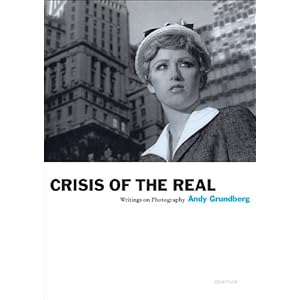
I have recently finished reading, "Crisis of the Real" by Andy Grundberg.

Crisis of the Real: Writings on Photography (Aperture Ideas)

This book compiles a series of essays written in the late 80's questioning the nature of photography in the postmodern world.  The treatment as a series of short articles each discussing a specific genre or photographer makes this an excellent reference to place a photographers work in context of others and versus the debates of the day.  Most of the photographers are from the usual pantheon of American artists, the author was a journalist for the New York Times, and the articles tend to relate to exhibitions taking place at the time.  The lack of photographs illustrating the text can be a problem, but is easily remedied via the web or by reference to other books.

The principal thread of the book is an ongoing discussion of how photographs come to be seen as art and where a given photographer contributes or not.  What fascinated me in the earlier parts of the book was the first real criticism I have seen of Ansel Adams.  In the introductory books on photography Adams tends to be eulogized, here he is praised, but also criticized for his presentation of a perfect natural world that in fact does not exist.  This is an element of the discussion of whether a photograph has any claim to represent reality or whether it is simply a reflection of the artists personal view of reality.  In this context he contrasts the work of the two Adams's, Ansel and Robert, both of whom image very similar natural landscapes, but from dramatically different viewpoints.  Ansel's vision is of a wilderness untouched by man, Robert presents the wilderness as it is now, full of people often inspired to be there by Ansel's work in the first place.  Both are accurate renditions of scenes, neither tell the truth.

This comparison is at the heart of my understanding of this text.  Grundberg moves from the modernist tradition led by Stieglitz, through other artists such as Weston, Minor White, Nagy, Riis, Adams towards more contemporary artists such as Friedlander, Cindy Sherman, Winogrand, and Sternfeld.  In each case he asks the question, is this art and how does it relate to contemporary thinking (well late 80's). He also covers the crisis induced by television on documentary photography and how what was once seen as cutting edge news reporting is increasingly being consumed on gallery walls rather than newspaper pages.

This is not an easy book to read and some chapters I chose to skim with an intent to return as I learn more about the issues discussed, however, this is an excellent critical overview of American photography and how the art world sees photographic imagery.

I have now turned to a more introductory text, "Photography, a Critical Introduction" edited, by Liz Wells, hopefully to make more sense out of what I have read in Grundbergs book and also Charlotte Cotton's "The Photograph as Contemporary Art".

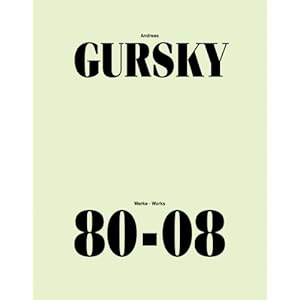
Finally I am also gradually expanding my collection of photo books by artists that I particularly admire.  On the recommendation of my tutor I have taken a look at Andreas Gursky's work and obtained the following

Andreas Gursky Works 80-08

Gursky interests me in two ways.  First of all his approach is very structural, recent images have strong symmetry and strong colour, secondly as a German and a graduate of the Dusseldorf School, living in Munich I have better access to his work and that of others from the same school.  Although I am currently working on  Assignment 3, my thoughts are turning towards Assignment 4.  As part of that assignment I would be interested to capture some images in a similar vein to Gursky's work

Assignment 3: Narrowing Down

Having spent the last three weeks on a mission to explore and photograph as many buildings/space as I could I am slowly starting to form an idea of what might constitute my submission for assignment 3.  I have now completely rejected the idea of a single lens, single style approach; the subject matter is too diverse and I think this would be more appropriate as a methodology for assignment 4.  I have thus gone in the opposite direction and selected buildings and associated photography with variety of expression as the goal.

I have also tried to resist a natural desire to create architectural photographs and as such most of my photographs will emphasize human activity and occupation rather than dramatic perspective and structure.  There will still be an element of architecture, necessary to illustrate the spaces I have chosen, but more limited than I would naturally select.  I suspect that I am currently drawn towards a modernist style of thinking, desiring to create a clean almost perfect looking world, with limited contamination by humanity.  However, not yet properly understanding the major movements in photographic art and theory, I will reserve judgement on this.

This blog entry is thus a summary of the previous 16 entries, limiting my selection of buildings/spaces to 7, and with close to the requested number of images per building.  There is still much work to do, both in editing and potentially photography to improve/change some of the images.  A problem I have had in the past has been a tendency to overwork projects, sometimes to the extent that the final result is less than I started with.  Attention to detail is important to me, but I also need to develop understanding of when an image or concept is at its optimal development point.

The Pinakothek der Moderne


This is the first of two art museums that I am including at this stage, I may include both at the risk of them being to similar, however, these include the best images I have taken thus far for this assignment.  The advantage of such spaces is that they are architecturally significant and that people interact with the exhibits in a meaningful and relatively easily photographer manner.

My first image is an unashamed architectural shot designed to show the size and scale of the building, but also the  way that people have colonized what is in effect a sun trap:


Once inside the museum, most visitors will head down to the basement area to get rid of coats, ruck sacks and perhaps to hit the facilities.  The staircases are dramatic and exist in an area where there is constant traffic.  This has enabled me to capture an image that includes multiple people but also shows the light and space in which they inhabit


The next two images are about how people interact with the exhibits in the museum, in this case a large bac klit frame containing objects designed by Luigi Colani.  This throws the people into silhouette and emphasizes gesture versus personality


The first of these two provides a better overall view of the exhibit and the different ways in which people are observing it, however, the second image captures better the interaction, almost presenting the two children as part of the exhibit

The Brandhorst Museum


The second museum has a very different character and yields quite different images, the first is again very architectural, taken using a tilt shift lens to preserve perspective, however, I have very deliberately ensured that there are people in the frame to add proportion and show how the building exists within the surrounding environment


The next image is inside out to the one above.  Within the museum are areas where people can sit and contemplate what they have seen.  This area is just behind the window seen in the above photo and overlooks the overall museum complex.  I like the strong contrast between the bright world outside and the dark inside, exposing and then processing this image was not easy


My final image from the Brandhorst is a reversal of the images of people interacting with exhibits above.  This installation by Damien Hirst is a huge cabinet comprising rows of tablets on mirrored shelves with a mirrored background.  I think the intent of the piece is to see your reflection against the 1000's of pharmaceuticals you will consume in your lifetime.  What it also presents is an image from within the art work of people observing, including inevitably the photographer.  This photograph might be possible without including me, perhaps by combining two separate images using a lateral shift in a lens, each taken from left and right of the piece.  However, I like the idea of the photographer being part of this work


Munich Cathedral


This is a difficult building to photograph, the sheer size makes finding a usable perspective difficult and the lack of light makes hand holding a camera a tough ask.  What I am drawn to in this church is not the architecture, but the people and the sacred nature of building.  The first image I have chosen tries to capture a persons quiet reflection after she has lit a candle, perhaps to remember someone she has lost.


Another similarly lit image, although using artificial light this time, is the following taken in the crypt.  I was very much taken with the selective lighting of the cross and noticed that as people walked through the crypt they were occasionally illuminated by an overhead spotlight.  I sat for around 30 minutes just waiting for someone to enter the light.  I wanted to balance the light on the cross with an individual picked out in the gloom, almost as if the light of heaven had picked them out for a moment


I may leave it at this, neither shot captures the building, but both capture the sacred nature of the space and the thoughtful way in which people interact with it.  If I have to select another image I would try to contrast the private spaces above with the massive volume of the interior and how it dwarfs the people inside.  The following is typical, but I may need to go back and work a better image.  perhaps something early in the day when few people are present


The Fünf Höfe


Moving from spiritual to consumerism, my next subject is a large and very elegant Munich shopping center.  Within this space I want to capture the colour of the shops coupled with the flow of people through the structure.  This image shows the largest of the open spaces filled with moving people.  The image is a slow shutter and is not the sharpest, however, I do not believe that pin sharp images are needed every time.  This picture is designed to show movement and colour


Within the arcade I also wanted to capture people stationary, in the following case eating. I am not sure about the quality of the image, although it has interesting colour and structure, worth a risk


As a shopping center is about shops, following are a couple of images of store fronts.  I have deliberately allowed space in front of the shops and deliberately included passers by, again to capture the business of the space, avoiding too much architecture


The final image is taken in another of the 5 "courts", this one dominated by a massive spherical sculpture hanging above the shoppers.  Again I am including people across the frame, although this time the shutter speed is high enough to avoid blur.  When I look at the photos of people that I take these days I am shocked at how many have a mobile phone attached to the ear


The Hofgarten


This is not a building as such, but a space defined by and including buildings.  This formal garden has too many different uses to illustrate here.  My treatment is focused upon the people rather than the buildings, although this first image is designed to capture the overall environment, a simple but atmospheric image


Tourism, plenty of that in Munich.  These two people, maps in hand, walk through rows of purple and white flowers.  Not sure about this one, it shows the formal structure of the gardens interrupted by visitors, but perhaps to snap shotty


In the center of the formal gardens is a small temple that provides a great location for busking, good acoustics and cover from the weather.


This rotunda also provides a good location for wedding photographs, although this photographer seems not too pleased at the number of other people present, especially someone pointing a camera at him and his couple


Finally large areas are covered in fine gravel and attract people playing Petanque.  In both of these images I have very deliberately tried to include the surrounding buildings to place the players in context


Not so sure about this space, some of the images works very well, but I am not sure if I am capturing the nature of the space

Muenchener Freiheit Subway Station


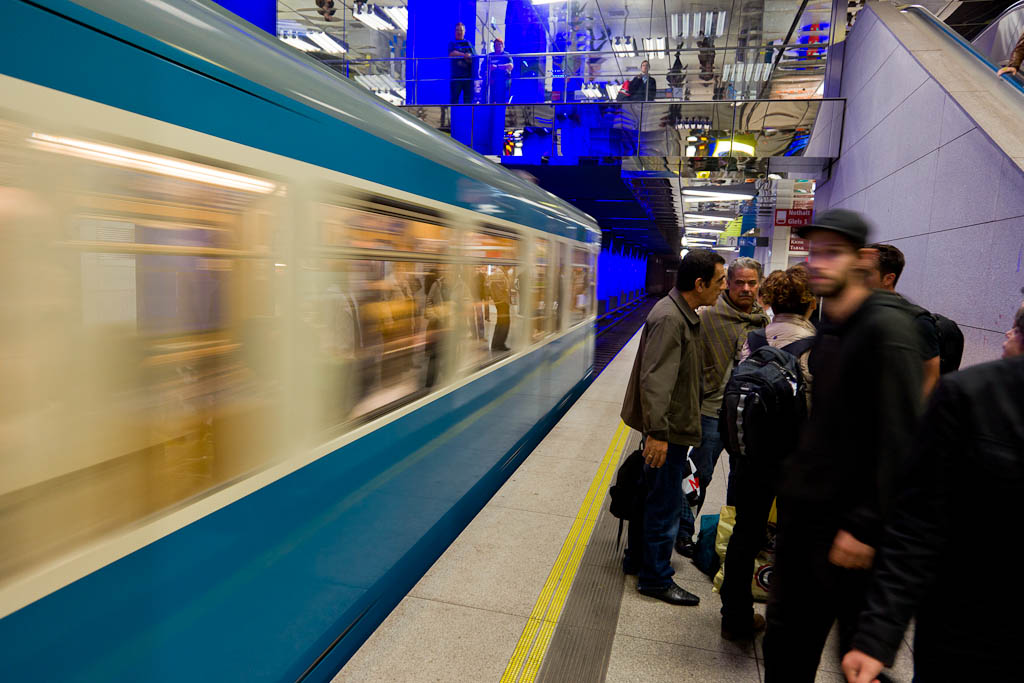
The challenge with this location is not finding photographs it is editing down to the 2-4 needed, there is so much material within a small area and the recent dramatic internal makeover creates strange images.  However, first of all this is a space for catching trains, the following shot is another with slow shutter speed that emphasizes movement.  This one has the added advantage of the stationary group in the right of the frame waiting for the incoming train


A key purpose of a station is to move people to and from trains and I think the stair cases have to be part of any coverage.  The following photograph tries to capture the flow of people from a recently arrived train


A key design element in the station is that every ceiling is mirrored, even in the entrance area where shops are sited to sell food and drink to travelers.  The next photograph is a bakery showing the vastly varying lighting within the station.  I used a gray card and colour checker to profile my camera during this shoot, white balance could be anywhere


The final two photographs in my current selection for this building emphasize the reflections in the station, but also try to pick out a single traveler within this huge space.  I am not sure which of these I would use.  the first contains a little too much empty space, whilst the latter has a poor perspective


The Olympic Tower


The observation deck of the Olympic Tower offers a helicopter view of the city of Munich and enable dramatic photography on the right day, however, overhead shots are not the goal of this project and so in the next 4 photographs I am trying to illustrate the building rather than the view.  Having said that a key element of such a building is to provide access to that view:


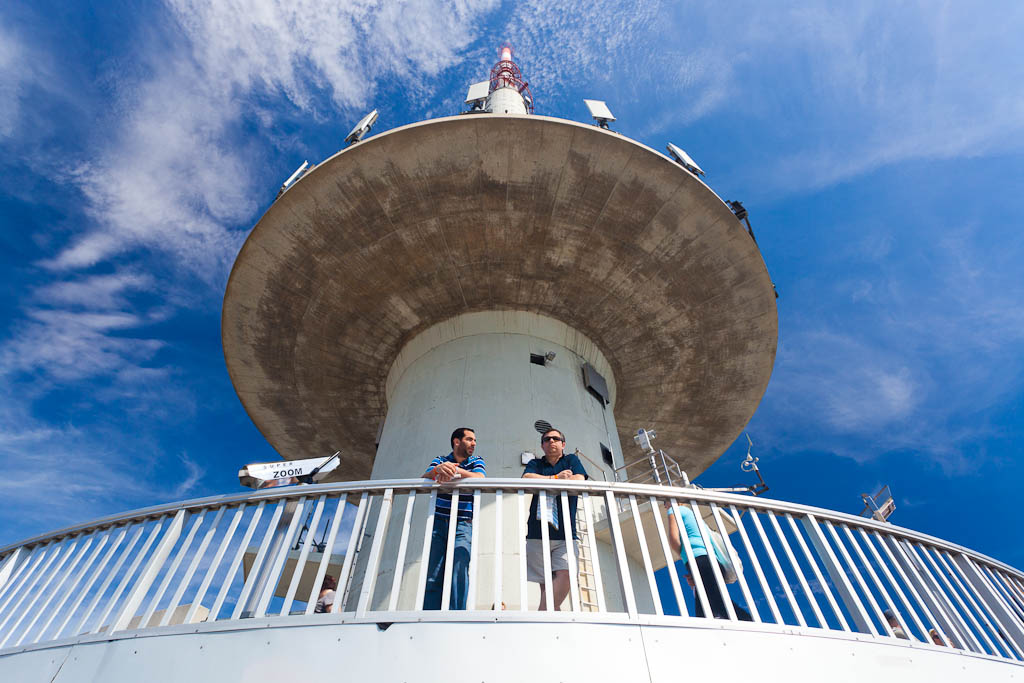
Looking back up the tower presents a different perspective on two guys enjoying the view.  This images strength is symmetry slightly broken by the people in the frame


Looking along the viewing platform, this image is dominated by curves and strong shadows.  In processing I tried to releive some of the shadow, in fact the more I look at this it is partly the structure of the shadows that create the photograph


Finally get in and out of the limited space on the platform requires two very crowded lifts


Closing Comments


I am now at a point with this assignment where exploring more structures and spaces will not improve the quality of the submission, I now need to spend some time reviewing the photographs in this collection and deciding which to keep, reject or improve.  I plan to submit my final version at the end of September, in two weeks time so I have time to reflect and work a little more. Munich just got a lot more interesting with the start of the Oktoberfest, meaning that we now have an average of extra 500,000 visitors each day.  The city will be packed with people, most of whom will get very drunk at one stage or another, good food for a hungry camera.

Friday, September 17, 2010

Assignment 3.16 The Olympic Tower

The Olympiaturm is a defining feature of Munich's skyline, it's 291m height making it visible from virtually anywhere in the city and from a great distance away, quite visible from the Alps on a clear day.  It was completed in 1968 as part of the complex built for the 1972 summer Olympic games.  It contains a viewing platform, revolving restaurant and even a small rock and roll museum with some pretty cool exhibits (The Olympic stadium and arena being two of Munich's key stages for major rock and roll acts.  On the day I visited the Stadium was having U2's lighting rig installed for a gig two days ago.

As you arrive on foot, especially from the south the tower is a spectacular view, especially on a clear day


From below the height becomes very clear


However, the key interest in visting the tower is to pay 4.50 Euro and take the elevator to the viewing platform at 190m.  The view is stunning, the following 4 photographs show the 4 stations of the compass:

First looking South over the city of Munich towards the Alps.  As we arrived at the platform around midday the view is very hazy with the Sun in the south, however, the air was clear enough to make out the Alps in the distance.  The large church in the middle ground is the Cathedral that has been featured already in this sequence of images


Looking East, we overlook the BMW headquarters building and the ring road that encircles the city


North is the Olympic Village, built to house the athletes for the 72 games and also the subject of a previous post, the shadow of the tower acting as a giant sun dial, pointing almost due North


Finally looking to the West, are the buildings that make up the Olympic complex


A wider angle shot takes in the new BMW Museum with its roof covered in solar panels and immediately behind it one of BMW's production plants


Whilst I appreciate that this blogs goal is to explore the interaction of people with buildings it is hard to resist presenting a few more images taken from the top of the tower.  The wide angle images are predominantly taken with a 17-40mm zoom coupled with a circular polar filter, the close ups are with a 70-200mm zoom, but no filter.

First a couple more shots of the Olympic village, a possible location for Assignment 4 image making


The O2 building and interesting road junction


A close up of the BMW HQ, built to resemble a flat four cylinder configuration


This is a close up of the new BMW museum


and the BMW factory immediately behind


However, my goal in visiting the tower was to take images of the building and the people who come to visit it. The viewing platform is on two levels, the upper level is narrower and does not have a safety fence, enabling shots to be made that include both visitors and tehe perspective of the landscape beyond.  Using a fairly narrow aperture enables both to be captured more or less in focus:


The final image in this sequence, capture a little girl just about to throw a paper plane off the tower, her mther intercepted just in time.  Shooting along the plane of the platform can create some interesting perspectives:


The above image is also an example of a figure small.

Moving into the core of the building there is also a viewing area behind glass, grubby glass


The small, but well stocked rock museum is rather a disappointment at first glance, however, close inspection finds some gems, this is a mirrored Elton John piano.


Finally, the big problem in the tower is the rather limited capacity of the two access lifts, meaning that there is always something of a scrum of people trying to get in and out