Saturday, October 23, 2010

Photo Shoot: Autumn in the Englischer Garten

Finally a crisp cold morning on which the temperature dropped below zero.  I headed out at dawn hoping to arrive in the city park just as the sun started to clip the tops of the trees.  I did not want to carry a tripod and so pre-dawn twilight images would not really be an option.  My goal was to try and capture the affect of the low sun on the landscape, especially the trees about half of which are now in full autumn plumage.  Another objective required a freeze to cause mist to rise from the warmer waters of the streams running through the park.

These images are unashamedly pictorial and represent another exploration of my personal feelings about landscape photography.  Do I have the interest to pursue a year long course and am I any good at this genre of photography?  I fully accept that I have no idea about the styles and techniques of landscape, but I still need to feel a spark of interest or intuition before committing money and time.

The images here were all taken hand held with my Canon 5D2 and image stabilized 24/105mm f/4 lens.  In all I captured around 150 frames over an hour, starting just at sunrise.  I have chosen the 9 images that interested me most, selection is simply based upon my own sense of the aesthetic, I have no idea whether they are good or bad.

The first image was taken before sunrise as I walked into the park across the bridge adjacent to the Chinese Tower beer garden.  I am becoming more interested in the muted colours of the landscape rather than the fiery blaze of sunlit autumnal foliage (last years obsession).  I think this is partially due to becoming more exposed to work of other photographers and a desire to present a more thoughtful image.  Fire has its place, but so does ice!


Within the park there is a small hill, the Monopteros, that offers a superb vista through the park and onto the spires of Munich's churches.  Surely this was designed very carefully at the time the park was laid out.  Through the middle of the frame runs a stream from which mist is rising.  The first shot (@ 24mm) tries to capture the depth of the scene and is then followed by a zoomed in (@ 105mm) image taken from the same location.


The blue-green caste of the grass is caused by the coating of ice on each blade, which I suspect is reflecting some of the blue of the sky plus transmitting the green of the underlying grass, anyway I really like this affect.  I also tried to capture this just as the sun illuminated the buildings, but before it started to burn off the mist and ice on the grass.

Walking from the hill into the middle ground of the second image (actually taken earlier) the following image is of the stream running through the park and the mist rising


Having dispensed with the "landscape" I now turn to the trees, which were my original goal for getting up so early.  Prior to the sun rising the soft light of dawn  presented a pastel toned world


Once the sun arrived the world changed dramatically and I discovered that silhouette might be more interesting than foliage


OK, these image are more fire than ice, however, the goal was one of exploration and this was a very interesting discovery.  The sun light was reflected strongly by the ice covered grass, providing the stripes of yellow light across the frozen ground.

In shade the world remained pastel


My final selection is an attempt (failed) at trying to create an autumnal image with some depth of field and stronger colour


Conclusions?  First of all I like being outdoors, I always have and when prodded properly am an enthusiastic hill walker, so being out in the dawn light was invigorating and gave me a chance to do some photography and still be at my desk by 9am.  Autumn, interesting, but not in direct sunlight, I prefer cloud or pre-dawn light, the dramatic Autumn foliage shots might grab attention in glossy magazines, but I think they miss revealing the real colour and structure of the trees, Pastel is the way forward for me on this topic at least.  Landscape, the jury is still out, the Landscape course would work for me if it is not too pastoral, I live in a city and cannot easily get out into the countryside, but then again there is a landscape only 30 minutes walk away as today proved.

Reading

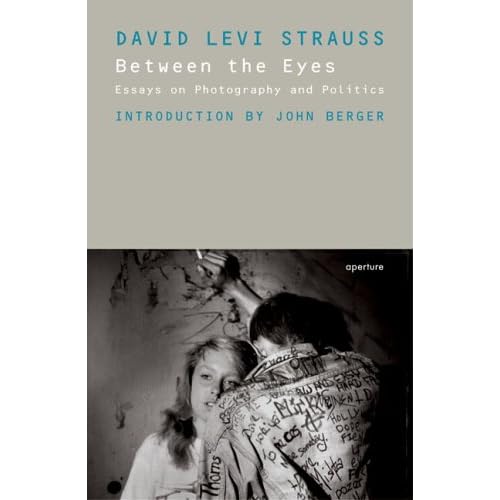
Continuing my ongoing interest in both critical theory and the history of photography, the next book I tackled was one taken from the reading list for the course, "Between the Eyes: Essays on Photography and Politics" by David Levi Strauss.


Compared to the last two books, Sontag and Berger, this was relatively disappointing.  The first few essays, particularly those covering Land mines and Rwanda, were both moving and informative about how photographers approach such difficult and tragic situations.  The discussion of how photographer Alfred Jaar dealt with what he had seen and captured on film related how it took years before he could present the images and the special way he handled the challenge of such difficult work.  The text dealt with the power of the image "The Eyes of Gutete Emerita", which simply showed her eyes each in its own frame reflecting the horror of what she had witnessed without actually showing it.

The discussion of the lives and deaths of two dedicated documentary photographers, Richard Cross and John Hoagland, dealt with the difference between photographers who engage fully with their subject versus those who arrive grab some images in a couple of days and then get out again.  However, both Cross and Hoagland paid with their lives for their commitment, photography can be a dangerous business; as McCullin pointed out in his biography, text journalists can write their stories from anywhere, a conflict photographer has to be in the action to capture their story.

However, after these essays the others were not at the same level, frequently reviewing work by photographers I am not familiar with, but less effectively than say "Crisis of the Real" by Andy Grundberg.  Worth reading and thought provoking in places, but not as good as other books I have read recently.

Sunday, October 17, 2010

Photo Shoot: Oxfordshire Landscape

Last weekend I traveled to my family home in Oxfordshire, probably for the last time.  My father died two years ago following complications in what should have been routine surgery.  He was a physicist, turned artist in retirement and my influence in many aspects of my life.  The fact I embarked on this course is, I believe, largely a reaction to his early death and my desire to do something more with my life.  Mortality makes one think.  Since his death my Mother has continued to live in the house our family has called home for the past 32 years.  We moved there when I was 14 and since then this 300 year old Cotswald stone cottage has been a sanctuary and comfortable place to escape from the pressures of work.  

However, it is far to large for a single person and some of the spirit departed when Dad died.  Subsequently Mum placed it on the market and sold it in a couple of days.  She has bought a two bedroom flat in Oxford, much smaller and right in the heart of this beautiful old city.  I went home to sort through my Dads books, dividing them into piles for recycling, Oxfam donation, Mum to keep, and me to keep.  This was hard, especially throwing away books that had sat on shelves for 30 years, books carry much of the personality of a lived in space.  But, old textbooks are of no use and better to recycle into new books than to carry around as a dead weight. I also found a few very interesting art and photography books, some of which will be used in this course.

At times it was all too much and I needed to get out for a breather, so I used my time there and the excellent weather as an opportunity to do some photographic exploration.  The house is in a small village nestling in a shallow valley, surrounded by fields and containing some 12/13th century buildings that were formally part of a monastery, so potentially good subject matter. I also wanted to try my hand at a little landscape work, not my usual chosen subject, but one I may have to deal with at some stage during the course.  First of all this is the view from what was once my teenage bedroom, a 180 degree panorama rather badly stitched from 4 handheld portrait shots:


Notice how the cables do not join up, however, it is a good illustration of the village environment and a view I have enjoyed for 32 years.  The road in front of the house should be a straight line, this is a very distorted view!

Rather than present individual photographs I have organized the images created into themed contact sheets each with 9 images.  The photographs were taken using a Canon 7D and either a 10-22mm wide angle zoom or a 17-55mm f/2.8 image stabilized zoom.

My first study concerns the placement of the horizon within the frame and the different textures of the fields that form the foreground.  I also found the starkness of the wire fences contrasting with the sky quite interesting.  The emptiness of much of the landscape was quite striking, although the angle of the camera and my own placement could quite easily transform a shot from a pastoral study of the folds of hills and tree lines into a bleak desert.

Another feature of this landscape was the recently plowed fields creating a strong contrast between the brown earth and the green of the surrounding field edge, left unplowed to act as a footpath.  The different shapes that this created form my next study.  Once again the placement of the horizon is a key feature, but in these images it is the curve of the field edge that is the dominating structure.

Within the complex of the fields are a large number of areas that can best be described as heathland, containing long grass and scrubby trees.  The next study focuses on the trees and the hedge lines that divide the fields.

The dominant structure in the village is a huge medieval Tithe Barn, built around the 13th century and the main reason anyone comes to the village.  As kids we used to play here, nowadays I use it as a photographic playground.  Weather is critical for photographing the barn as the  stone really glows in the sun and it is important to balance the barn with the sky.  This time the weather was kind and the light reflecting from the barn was well balanced with the sky enabling a good balance. In these images I have tried to emphasize the triangular forms created by different perspectives and how the barn sits inside its own local landscape.

My final panel deals with multiple subjects and is a catch all with a few images of the village from inside and outside the family home.  Danes Cottage - our home is the house covered in the red Virginia creeper in the top middle. The bottom row has a few more "landscapy" shots, badly done and not at the best time of day for such things:

As well as creating the contact prints I also took a more detailed look at three frames.  The first is a close up of a hedge row, a complex matrix of interlocking branches.  I had seen some images of this nature by Lee Friedlander and wanted to attempt something similar:

In a rare departure from colour I also processed this image into monochrome, enabling me to push the contrast far further than with the softer colour image.  I still do not like black and white imagery, especially digital B&W, processing a colour image as black and white for some kind of artistic effect bothers me.  However, in this case I prove myself wrong as the B&W image is much stronger, it places focus on the structure of the content rather than the colour.  Maybe I will one day cross over to the dark side, although if I do, I want to do it with film and pull out my underutilized EOS 3.


Another image that really struck me at the time of taking is the following landscape, taken looking up a hill.  This is very reminiscent of the recent photographs taken of the surface of Mars.


My last image is a conceit, I found just 3 poppies in a day of wandering.  They sat in some long grass on a gentle slope.  Placing my camera on the ground and pointing upwards:


I like it, but it is a little picture postcardy!

So, landscape photography?  I enjoyed taking these image, walking through the fields and taking pictures actually made me look closer at the fields than I have ever done before.  My approach and the images taken are very structured almost geometrical, straight lines and strong shapes, or are very busy such as the hedge rows or trees.  In the image set I find myself drawn to structure and form, looking for detail.  I am almost repelled by the "painterly" approach, the creation of misty landscapes holds no interest.  I enjoy looking at such images, but am not drawn to make them.  This is the first time I have purposely gone out to photograph the landscape, rather than simply shooting interesting things that might include a landscape element.  Do I want to do the landscape course, MAYBE?

Finally this was also an exercise in irony coupled with a deep melancholy and sadness.  I suspect that this is the last time I will ever visit my family home and walk through these fields or visit the Tithe Barn.  Strange that this is also the first time I have made anything like a serious photographic study of the surrounding countryside, finding great interest in what lay within this small patch of countryside.

Reading

Been a while since I last made a post here, due to heading home to the UK last weekend.  However, the fact that I would be spending around 12 hours either waiting in airports, flying or sitting on buses meant that I had plenty of time to read a couple of books that have been on my list for some time.

The first book was purchased when I started the AoP course a year ago and then sat on my shelf glaring at me, having been put back there after reading a couple of paragraphs and thinking, "what have I got my self into".  In fact on a second attempt I found Susan Sontag's "On Photography" to be very readable (although I still have no idea what Plato's Cave is!).  Her style is easy going and well paced, although it does need a degree of concentration to work through.  As with all books of this nature a single read is not enough and this volume needs more careful study, however, I do find myself gradually building a more critical understanding of the values and motivations of photographers.

On Photography

A few take aways from reading the book, at least those that stuck with me, are:

  1. The debate about the truth of a photograph and the degree to which a photograph reveals the subject or the photographers vision of that subject
  2. That photography creates beauty.  Her view is that photographs are rarely deliberately ugly, even if the subject is the artist will frame and manage the composition in such a way to derive beauty from the object.  The Becher's study of industrial objects is a great example of this.
  3. Photographs have become a substitute for experience, even when people visit places of great interest there view is frequently through a viewfinder or LCD screen.  Once the photo is taken they move on not taking the time to truly appreciate the scene for what it is.
  4. The observation that photography liberated rather than threatened painted art by removing the need for painted art to be used as a recording medium.  Photography could provide the mundane portraits and dull landscapes freeing artists.  However, if I was a jobbing artist making a living from commissioned portraits I would have seen this very differently, or gone out and invested in a camera.
  5. Photography concerns itself with people on the edges of society, deemed to be interesting: the poor, the very rich, the odd or the disadvantaged - her commentary on Diane Arbus studied this in detail.  I think perhaps it is not simply an obsession of photographers, but also of the viewer in what we find interesting and ultimately remember as the great images.
The other book thrown into my bag, was John Berger's "Ways of Seeing".  This was a far shorter book, but more difficult to understand, particularly the purely visual essays, I guess my visual vocabulary is still very weak.
Ways of Seeing (Penguin Modern Classics)

This volume had less to say about photography, being primarily concerned with traditional oil painting and how we experience it, however, photography was still a major thread within the text.  Again, here are my most immediate thoughts on what I read
  1. The observation that almost all "great" paintings are actually statements of wealth, look at me, look at my wife and children, look at my possessions, look at my home and land!  Paintings were commissioned objects, paid for by the wealthy to record their status permanently for themselves and family to admire and for other to envy.
  2. This contrasted with the fact that almost all artists who espoused such work lived and died in poverty and that such paintings are far fewer in number.  
  3. He points out that photography has completely transformed how we experience great art, by detaching the image from its context within a building and reducing the artists personal style and presence.   Before photographs, to see a painting you had to travel to it and observe it in situ, now anyone can purchase a book or pull up a web browser.
  4. He also draws a strong parallel in one essay between classical paintings and the structure and form of photographs used as advertising images.  Whilst the content is very similar, and the goal shares a common thread, wealth and envy, there is a key distinction.  Paintings convey existing wealth with the intent that the viewer should envy the subject.  Advertising images, on the other hand, say that you the viewer can be envied, but only if you purchase the product advertised.  Although this used the images of the 70's when the essay was first published, this is still very true, although I think modern advertising depends less upon classical forms.
Two quite different books, but both complementary and thought provoking.  I have just added "Camera Lucida" by Roland Barthes to my book shelf, next on my list, although I suspect this will be more challenging to read and understand!  I have also recently added many photo books by artists that interest me, I plan to start reviewing and recording my thoughts on these over the coming weeks.

Sunday, October 3, 2010

Assignment 4: Sunday 3rd October

One of those bizarre days in Germany a major public holiday today, reunification day, but falling on a Sunday so no day off.  At least this is better than when it falls on a Saturday and the shops close to compound the insult.  However, the weather gods were smiling and a superb Autumn blue sky dominates the city.  As the temperature headed over 20 degrees the populace hit the parks and the river bank to soak up the sun and enjoy a beer or two.  For me, no beer, but a chance for a different look to my Haidhausen photographs.  This is my last day to work on the assignment for 2 weeks as I am going to traveling during the week and over the weekend.

The blue sky called for a revisit to the river to try and capture some more landscape style images of the Volksbad.  I also opted to switch to a wider 17-40mm zoom than the 24-70 I used yesterday.  I also added a polarization filter to the lens as the glare from the river would be very strong, but also to deepen the blue of the skies.  To a degree this looks overdone and I may have to rethink the processing.


Off the river this is the view looking up the hill towards the red brick Gasteig concert hall


Back on the river, I walked back to the foot bridge connecting Haidhausen to the city center


Then crossing the bridge:


Turning to shoot into the sun:


The view from the Haidhausen bank of the river back towards the city center


Leaving the river I opted to walk through Wiener Platz looking for some street photography opportunities


Well that's it for a while - the variety and content so far are OK, but I feel there is much to do and am guessing I will need another 2 or 3 weekends to complete this assignment.

Assignment 4: Saturday 2nd October

Busy day today, managed to get out of the house twice with my camera.  This time I left the tripod and tilt shift behind, opting for a "lighter" kit of my 24-70mm and 5D.  The skies were still grey, but the denser cloud meant that the brightness had a dropped a little and contrast is better in the images.  I was a little lazy and so took public transport to Max Weber Platz with intent to walk along the river and capture some landscape shots.

First of all I had to head through Wiener Platz past the Cafe bearing its name and through the beer garden which on a cold day looked sadly forlorn:


Heading down to the river I passed the Bavarian Parliament, an odd building that I cannot decide if i like or loath, anyway they are having an open day in two weeks time, so I may get a chance for a closer look:


Crossing the river, the quality of light is strange, but supports taking photographs that balance sky and landscape.  I exposed for the sky and then lightened by about half a stop, this left the trees dark and required some brightening in Lightroom:


There is a pedestrian walkway running down the middle of the river actually over a weir.  On one side the run runs naturally on the other it runs through an artificial channel and is kept deep:


On an island in the river, an Oktoberfest victim sleeps off the beer.  At this time of the year people can be found sleeping rough all over the city.  Hotels are very expensive during the fest and many people come unprepared:


On the Haidhausen side of the river is the Volksbad, a late 19th century swimming pool housed in a very elegant building, very much a feature of Haidhausen's landscape:


Heading up the hill the following photographs are from a public area behind the block of flats where Heidi and I used to live.  All over Munich residential areas frequently hide unusual and beautiful spaces set aside for relaxation and simply to allow the people to breath:


I am interested also in the juxtaposition of public transport with the streets, the trams in particular make an interesting site as they trundle through otherwise pedestrian areas:


Just behind Max Weber Platz I found some street life


And a small photography course:


And finally for today, a kid roller skates past one of the districts churches: